
Mississippi Public Mugshot Laws
No Mississippi statute flatly bans publishing booking photos. Nor does one forbid private publishers from charging removal fees. That gap is not blanket permission. The Public Records Act sets a broad access rule for records held by public bodies. Separate laws can still make specific names or files confidential. A narrower rule may govern a particular record.
A mugshot is one piece of a booking file. It documents an agency processing a person. To describe an outcome, check the court disposition first. That record shows what the court actually decided. Confirm custody with the agency that holds the person now. The photo alone settles nothing.
The Mississippi Ethics Commission's Public Records Act overview explains which materials count as public records and how requests work. The first question is simple. Does a public body actually hold the record? Other rules can restrict disclosure, or a court or agency may have changed the record's status.
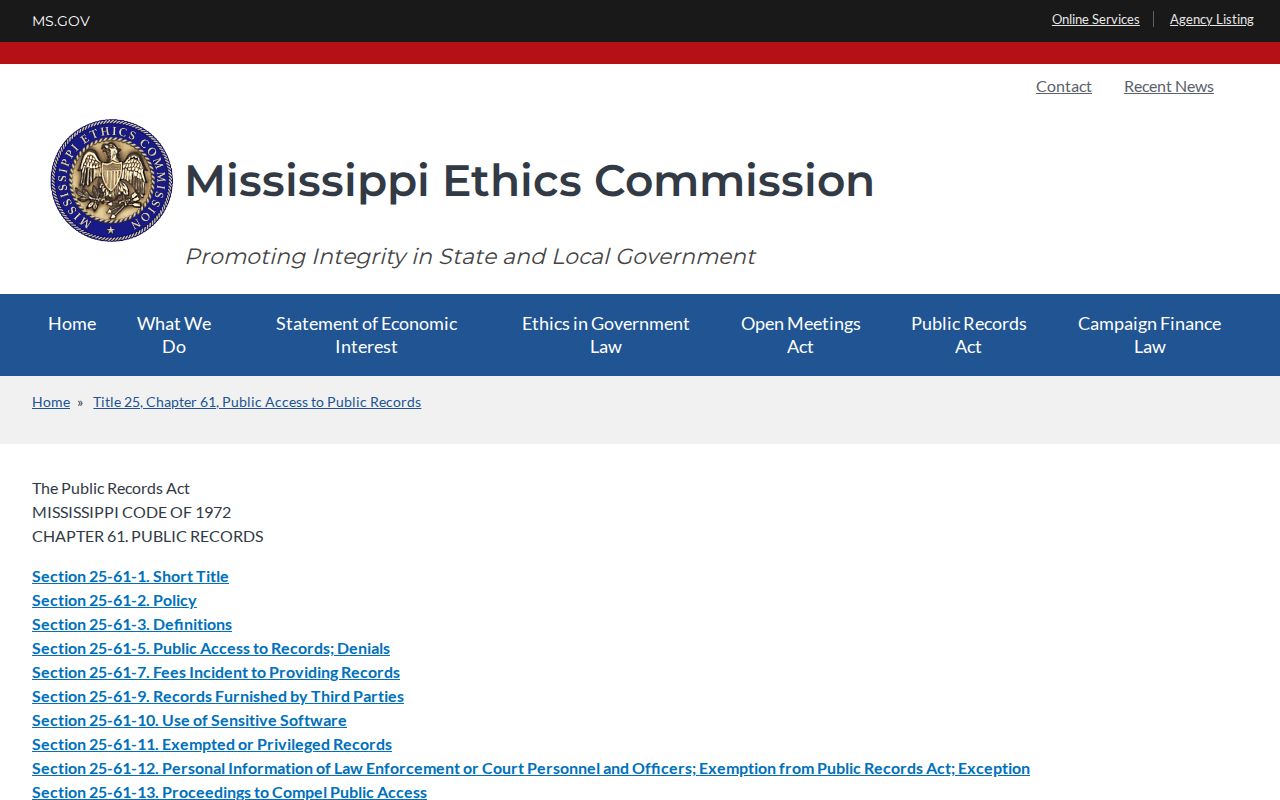
A definition is only a starting point. Public status does not mean a photo appears online or can be copied without review.
Mississippi Public-Records Rules
Mississippi Code §§25-61-1 through 25-61-17 contain the Public Records Act. Section 25-61-3(b) lists photographs among materials that may be public records when used in public-body business. Section 25-61-5 lets any person inspect, copy, or reproduce a public record, subject to lawful exemptions. The Act does not unlock every file. Section 25-61-11 preserves other confidentiality rules. Agencies may therefore withhold or redact protected material.
Timing rules matter under the Public Records Act. An agency lacking written procedures must provide access within one working day. Adopted procedures cannot push denial or production past seven working days. Miss that mark? The agency owes a written explanation of why. Absent agreement or the competitive-proposal exception, production is due no later than fourteen working days after the request. Fees may recover actual and reasonable costs. Narrowing a search helps. Provide a name, date range, booking number if known, record type, and preferred format. If material is denied or redacted, ask the custodian to cite the legal basis.
Separately, Mississippi Code §19-25-63 makes a sheriff keep a public jail docket. Entries list the prisoner's name, dates received and arrested or committed, the authority or cause, and release or discharge details. A docket is not a web roster or photo feed. A sheriff may keep the docket while posting no images at all. The introduced text of S.B. 2258 reproduces this requirement. Trust the current code and custodian instead.
Public status does not erase privacy limits inside an incident packet. Section 25-61-12 treats incident reports as public. Investigative reports are different. They may be released or withheld under the law. A victim's identity need not be disclosed either. Seeing victim details in a returned record is not permission to copy them.
| Record rule | What it means for a search |
|---|---|
| Public-record definition | A photo held for public-body business may qualify, unless a separate law limits access. |
| Jail docket | Booking and release facts may be available even if the sheriff does not publish a photo feed. |
| Confidentiality rule | Protected details can be withheld or redacted from an otherwise public file. |
Note: A public record can remain available through a written request even when an agency does not place it on a public webpage.
Misdemeanor and Juvenile Records
Mississippi guards misdemeanor names closely. Mississippi Code §25-1-109 bars an agency from releasing the name of a person arrested, cited, or held for a misdemeanor unless that person is formally charged and arrested for the offense. The law keeps a few exceptions. Other law-enforcement agencies, the Department of Human Services, child-protection efforts, and child-care suitability investigations may still receive the name. Treat the section as narrow. It is not a blanket privacy rule for Mississippi mugshots, nor a general removal right for copies already published.
Timing drives everything here. A misdemeanor arrest record can exist before any formal charge lands. The statute restricts the agency's release of the person's name during that covered period. A name on a third-party page proves nothing. It does not show the source agency could lawfully disclose it, so ask the originating office which record it holds and whether the formal-charge condition has been met.
Juvenile records follow separate rules. Many law-enforcement records involving children stay confidential under §43-21-255, subject to defined exceptions. Photographs and fingerprints may, in certain cases, be shared with publicly funded law-enforcement agencies, youth-court officials, and appropriate school officials for limited purposes. Youth Court case records are governed separately. Mississippi's 2026 Youth Court Reform Act revised those disclosure rules. Confirm current law with the court or agency first. The current text of §43-21-255 pairs with the Legislature's 2026 youth-court reform bill.
Leave a child's name and image off your page. A publisher's decision to display a minor does not make the release lawful. Ask first. When age or charge status is uncertain, check with the court or agency before copying or sharing anything.
Mississippi Records Still Available
A publication limit does not erase the underlying records. Each source answers a different question. An online absence, by itself, never proves a person avoided arrest. Start with the county. Use the sheriff or jail channel first for a current booking. If the roster shows no record or photo, ask the local custodian for the jail docket or a narrow booking-record copy under the Public Records Act.
Court dockets answer case status. Public Access to Mississippi Electronic Courts, called PAMEC, offers electronic case information for participating courts and nonrestricted cases. Registered public users can search dockets and documents. The official public-user terms list a $10 annual fee and a $0.20 per-page charge for documents. Not every court or record is online. A local clerk or courthouse terminal may still be needed for some records. Search by name, case number, court, and filing date. Then look for a dismissal, plea, trial result, sentence, acquittal, reversal, or expungement entry.
The PAMEC entry point marks the online route. For a complete court record, the clerk remains the source.
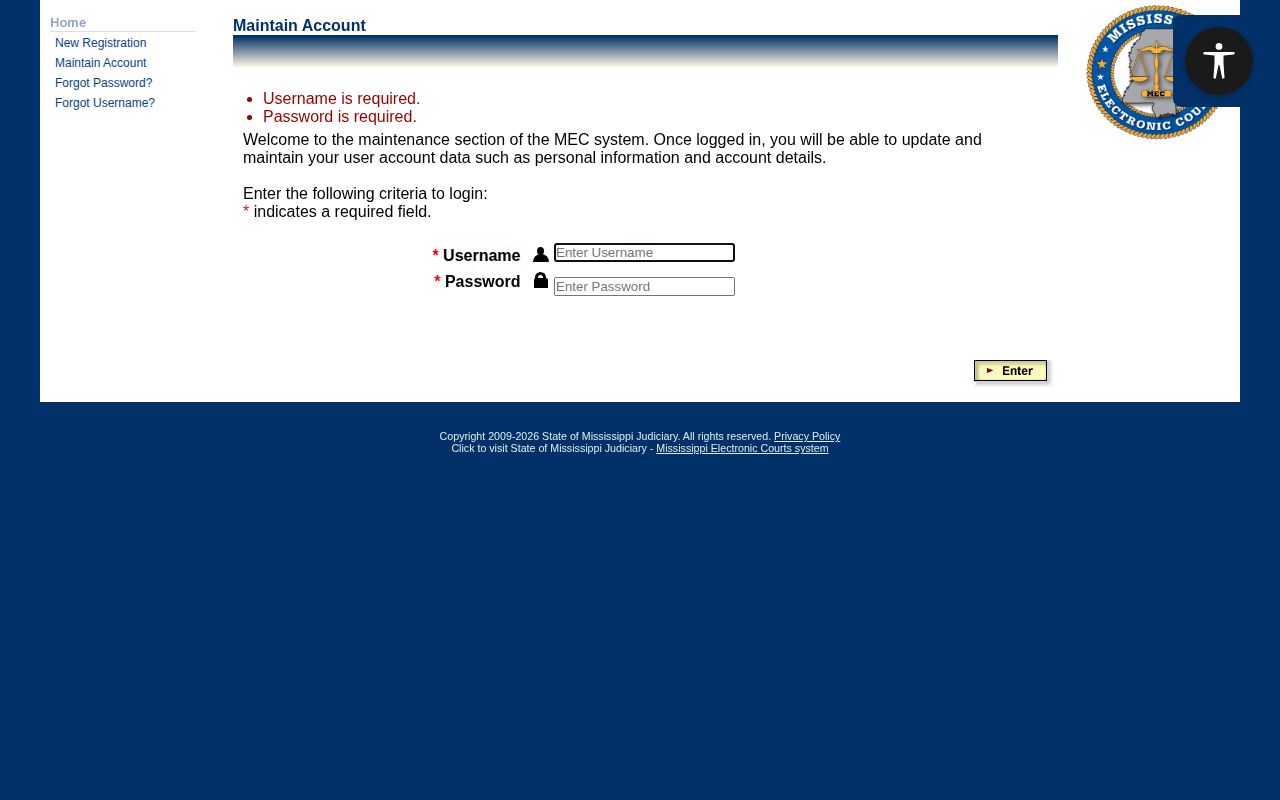
A court search can settle a charge's outcome. It cannot confirm current county or state custody. For a person sentenced to state prison, the Mississippi Department of Corrections offender search is the right tool, since a profile photo there is part of the state-corrections record, not a new county booking. The statewide arrest search maps the route from sheriff rosters and record requests to court and state-custody sources.
| Question | Best starting record | What it does not prove |
|---|---|---|
| Was a person booked locally? | County roster, sheriff, jail docket, or booking-record request | A charge is not a conviction. |
| How did a case end? | PAMEC for participating courts, then the local clerk | A court docket does not confirm present custody. |
| Is a person in state prison? | MDOC Inmate Search | An MDOC profile is not a county booking photo. |
Note: A court portal covers only participating courts and nonrestricted files, so a clerk may still hold the complete case record.
Expungement and Court Orders
Record-clearing in Mississippi runs through the courts. Nothing gets purged automatically. Under §99-19-71, a qualifying first-offender nontraffic misdemeanor may be petitioned for expungement in the relevant court. The same statute allows one felony conviction to be petitioned after five years from successful completion of all terms, conditions, fines, and costs, subject to listed exclusions. Eligibility turns on the details. Read the 2025 text of §99-19-71 for the full list of exceptions before filing.
A different path covers arrests without charges. When a misdemeanor arrest, citation, or hold never leads to formal charge or prosecution within the statutory period, or the case ends in dismissal, §99-15-59 lets a person apply to the court for expungement. Nonadjudication is distinct. That disposition may need a later court order to clear public records. It is not a statewide automatic deletion.
Once an order is signed, send it to every custodian holding a relevant record. The Mississippi Department of Public Safety Criminal Information Center states that an expunction order directs CIC to remove offenses from an offender rap sheet. Section 45-27-9 is the CIC purge authority. An order directs official record changes. Every custodian must then update its own copy.
Keep the correction trail clean. Ask the court with jurisdiction for current forms. The right path depends on the case outcome and the law in effect when the petition is filed.
- Confirm the exact court disposition and obtain the signed expungement or sealing order from the court or clerk.
- Identify each official holder, such as the arresting agency, sheriff or jail, court clerk, CIC, or MDOC when it holds a related state record.
- Send the order through each custodian’s stated process and ask for written confirmation of the action taken.
- For a separate private copy, send the publisher the exact page address and supporting court record through its current free correction process.
RecentlyBooked Correction Policy
A private publisher did not create your booking file. The court and the arresting agency hold the source record. A copied photo can linger online long after the official roster changes or the person walks free. So start at the source. Confirm how the case ended. Then save the exact web address of the third-party page you want fixed. From there, the publisher's own correction policy governs what happens next. Keep in mind this process is separate from an official expungement. An accurate old record may still stay up under a publisher's stated rules.
RecentlyBooked's Mississippi pages are an unofficial secondary source. Its posted correction policy accepts no-fee requests. Those requests cover dismissed, expunged, sealed, incorrect, outdated, wrong-person, juvenile, and duplicate entries. Expect to supply the page URL, the name, the arrest date, and the location. Add a reason and legal papers where they apply. Accurate current public records, though, get no promise of removal. Policies shift over time. Trust the live page over any old contact detail. RecentlyBooked's policy page spells out the documents a requester must provide.
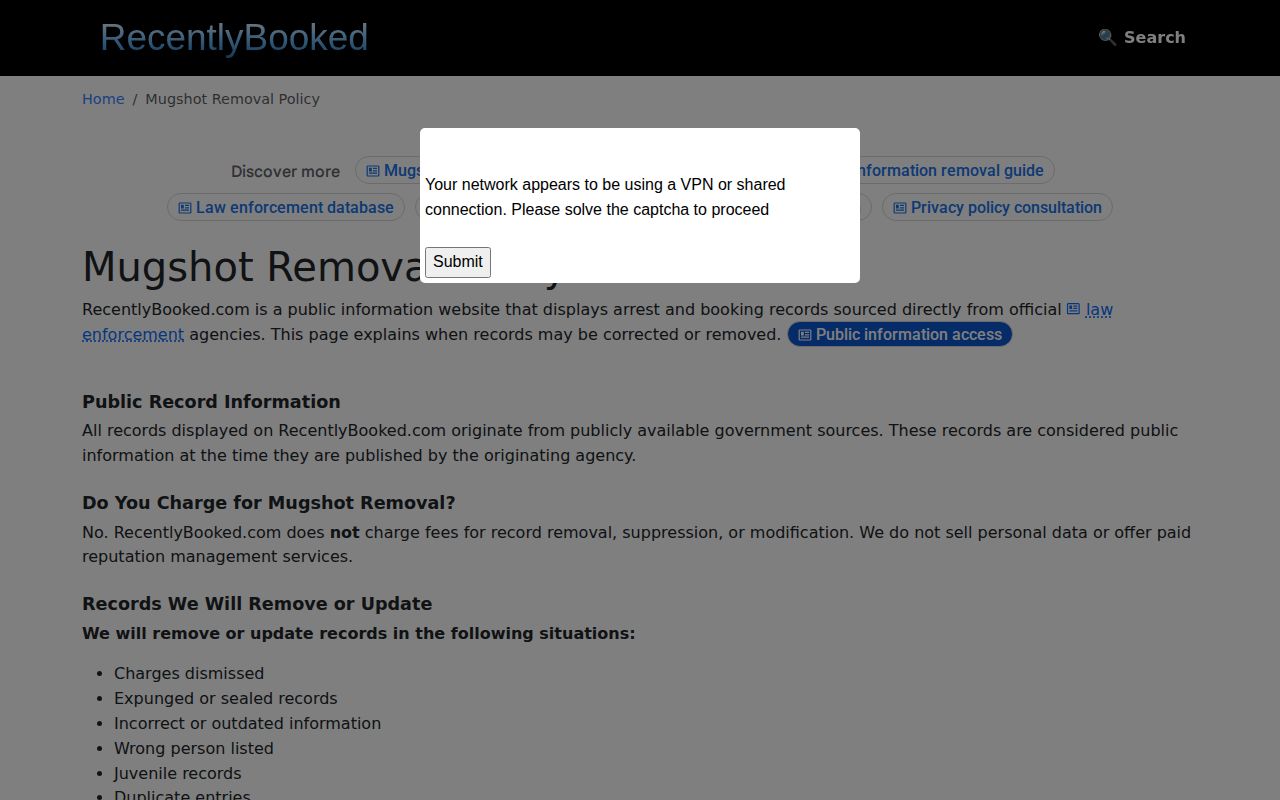
It is a private publisher's process, not an official finding that a record was sealed or expunged.
Note: A publisher’s free correction process does not replace a court order or an official custodian’s record update.
Free Publisher Correction Requests
Mugshots.com runs an unofficial Mississippi section. Its county pages and counts shift over time. The free record-maintenance policy covers documented expungement, sealing, restriction, identity theft, or death. It also handles updates backed by signed court papers. The publisher allows up to ten business days for processing. Mississippi law sets no such deadline. Treat that timing as the company's own stated window.
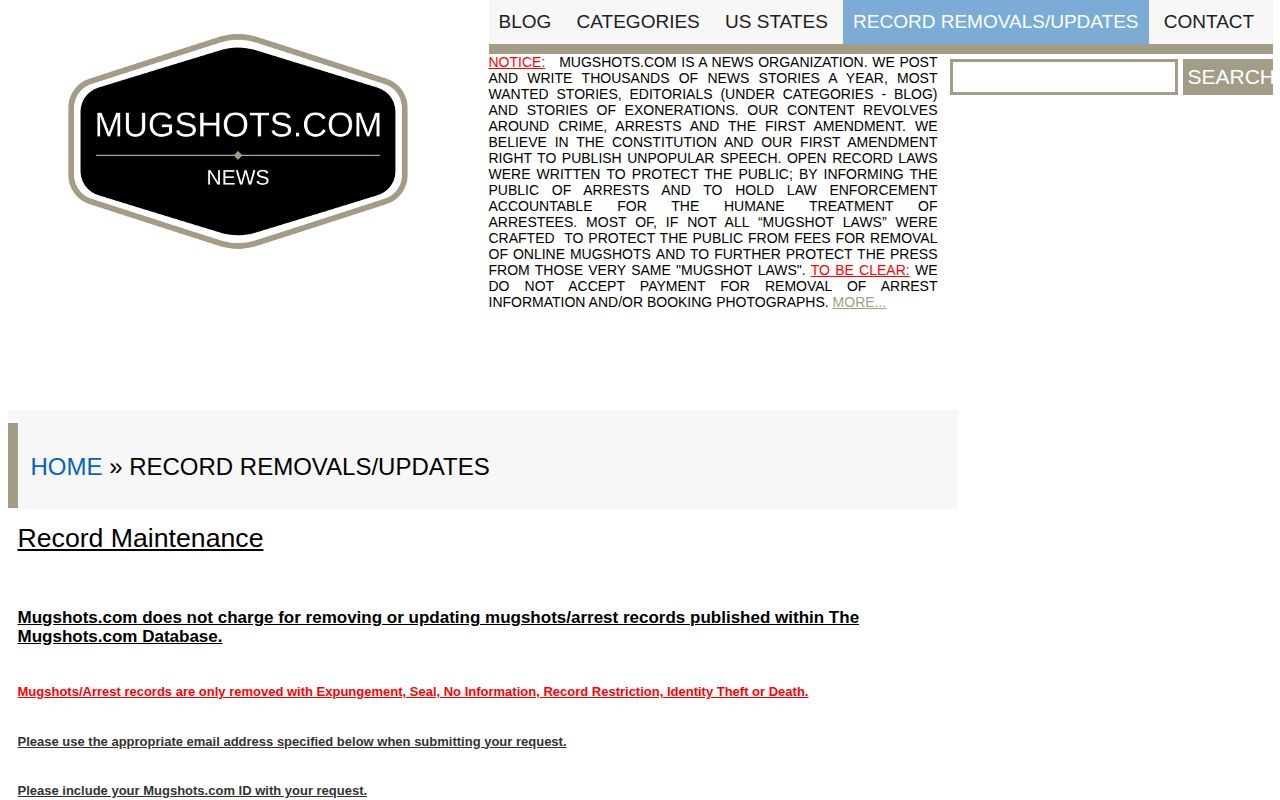
The free process belongs to a private publisher. It does not alter the official court or agency record by itself. Busted Newspaper's free listing-review process asks for the exact page plus legal documents showing an expungement, dismissal, nolle prosequi, not-guilty outcome, or sealing. The page states a five-to-ten-day handling window. It lists no fee. Even so, the process is not a general right to remove any accurate record. A contact form is neither an official correction nor a promise of deletion.
Watch out for anyone selling guaranteed removal from every site. No fee can lock that in. Mississippi law sets out no broad removal right and no sweeping pay-to-remove ban. Keep official records and private copies separate. Never send money on a promise nobody can back up.
Mississippi's Failed Removal Bills
Mississippi lawmakers have tried and failed to change this. A 2019 Senate bill, S.B. 2860, never became law. A 2022 House measure, H.B. 416, aimed at booking records under the Public Records Act, met the same end. So the state still has no broad removal right for people whose booking photos circulate online. The NCSL survey tracks both failed proposals alongside its state-by-state summary of these laws.
The NCSL survey is useful for legislative context. Still, the current code and a case-specific order control any real request. No Mississippi appellate decision has created a general right to strip every lawfully obtained booking image from every private page. A court order can change an official record's status. A particular claim may raise separate legal issues. None of that amounts to a promise of universal deletion. A careful record entry names its source, the date, the legal status, and the outcome when known.